 Minslite Series Catalysts for Ozone/CO/VOCs Removal
I. Introduction
Carbon monoxide catalysts are vital in the semiconductor sector. Copper-manganese oxide systems (e.g., Hopcalite) play a key role. They are used in high-purity gas production, cleanroom air purification, and process exhaust gas treatment. However, these catalysts gradually lose activity during operation. Many factors cause this deactivation. Engineering data shows that about 65% of premature catalyst replacements are directly due to deactivation. Therefore, understanding deactivation mechanisms is crucial. So are targeted countermeasures. They ensure long-term, stable operation of purification systems.
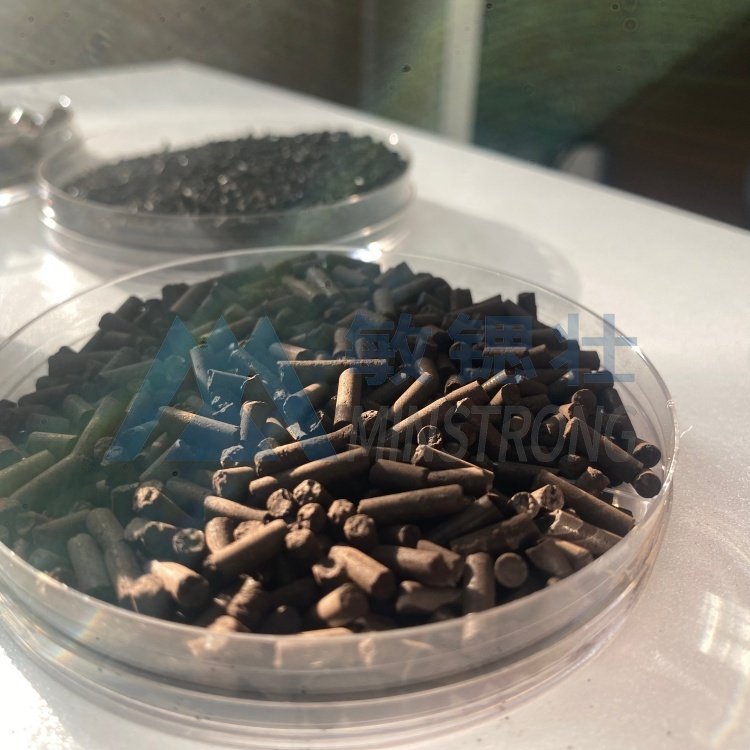
Carbon Monoxide Catalysts
II. Major Types and Mechanisms of Deactivation
2.1 Moisture Poisoning: The Most Common, Yet Partially Reversible
Water molecules compete with CO for adsorption sites on the catalyst surface. This hinders reactants from accessing the active copper-manganese centers. In environments with relative humidity above 60%, standard catalysts lose over 50% of their activity within just 24 hours. If humidity rises to 80% and persists for 72 hours, the CO conversion rate may drop from 98% to below 40%. Activity can partially recover once dry conditions return. However, repeated moisture shocks may cause irreversible damage to the catalyst’s crystal lattice.
Case Study: In a semiconductor air separation system, the catalyst’s conversion rate dropped sharply during the high-humidity summer. The inlet CO concentration was 2.5 ppm. The outlet concentration surged to 1.8 ppm. The design specification required ≤ 0.5 ppm. An inspection revealed that the dryer outlet dew point had risen from -45°C to -28°C. This resulted in a relative humidity of 65% at the catalyst bed inlet. After replacing the desiccant, the catalyst’s activity gradually recovered over 48 hours.
2.2 Chemical Poisoning: Irreversible Loss of Activity
Sulfur Poisoning: H₂S or SO₂ reacts with the CuO component of the catalyst. It forms CuS, which is extremely stable. When H₂S concentration reaches 0.5 ppm and persists for 24 hours, CO conversion drops by about 40%. After 72 hours, conversion falls below 20%. Standard regeneration procedures cannot recover the catalyst.
Chlorine Poisoning: Cl₂ or HCl reacts to form CuCl₂ or MnCl₂. This type of poisoning is even stronger than sulfur poisoning. Exposure to just 0.2 ppm Cl₂ for 48 hours can cause the catalyst to lose over 80% of its activity.
Case Study: In a specific CVD exhaust gas treatment system, the catalyst’s conversion rate dropped from 95% to 58% after six months of operation. Surface analysis showed a chlorine content of 3.2%. Fresh catalyst had less than 0.05% chlorine. After installing an upstream alkaline scrubbing tower, the same batch of catalyst achieved a service life of 14 months.
2.3 Thermal Sintering: Structural Failure at High Temperatures
The oxidation of CO is strongly exothermic (ΔH = -283 kJ/mol). When the inlet CO concentration surges suddenly or heat dissipation is inadequate, local temperatures in the catalyst bed can exceed 100°C. This far surpasses the optimal operating temperature range (0–50°C). A fresh catalyst has a specific surface area of 220 m²/g. After operating continuously at 80°C for 500 hours, its specific surface area drops to 95 m²/g. This reduces activity by about 60%. For every 20°C increase in temperature, the sintering rate rises by roughly one order of magnitude.
Case Study: In a high-purity gas production facility, an upstream adsorption breakthrough caused the inlet CO concentration to rise from 2 ppm to 15 ppm. The vigorous reaction made the center of the catalyst bed reach 95°C. The radial temperature difference was 25°C. After that, this batch of catalyst never recovered to a conversion rate above 90%.
III. Systematic Prevention Strategies
3.1 Prevention of Moisture Poisoning
Upstream Drying: For air separation and high-purity gas production, the dryer outlet dew point should be ≤ -40°C. For exhaust gas treatment, relative humidity should be ≤ 40%. Install an online dew point monitor and alarm system.
Selection of Moisture-Resistant Catalysts: Some scenarios cannot completely avoid moisture. Examples include the fresh air intake sections of cleanrooms. In these cases, choose catalysts modified with rare-earth doping (Ce, La) or hydrophobic carriers. Such catalysts maintain over 80% of initial activity for more than six months at ≤ 90% relative humidity.
Periodic Regeneration: Catalysts that have suffered moisture poisoning can be regenerated. Purge them with hot nitrogen at 80–100°C for 12–24 hours. This restores 70%–90% of initial activity.
3.2 Prevention of Chemical Poisoning
Upstream Removal: For sulfur- or chlorine-containing waste gas, install upstream alkaline scrubbing towers. Use 5%–10% NaOH solution. This removes over 95% of HCl and Cl₂. Also install activated carbon or molecular sieve adsorption beds. Use an inline pH meter to monitor the alkaline solution concentration.
Early Warning Monitoring: Install inline H₂S and Cl₂ detectors at the catalyst inlet. Set alarm thresholds at H₂S > 0.1 ppm and Cl₂ > 0.05 ppm. If these limits are exceeded, activate backup pretreatment systems or shut down to investigate.
Poisoning-Resistant Catalysts: Select catalysts with sacrificial components (e.g., ZnO). These components react preferentially with sulfur or chlorine. This protects the primary active components.
3.3 Prevention of Thermal Sintering
Activity Matching: For operating conditions with large fluctuations in inlet CO concentration, choose catalysts with moderate activity and superior thermal stability. The guiding principle is to ensure outlet emission standards are met. Do not blindly pursue the highest possible conversion rate.
Temperature Monitoring: Establish at least three temperature monitoring points across the radial cross-section of the catalyst bed. If the radial temperature difference exceeds 10°C, inspect the gas flow distribution. If the bed temperature exceeds 70°C, reduce the inlet CO load or enhance heat dissipation.
Space Velocity Optimization: For waste gas streams with CO concentrations of 500–1,000 ppm, design the space velocity to be about 15,000 h⁻¹. This balances conversion efficiency and temperature rise.
IV. Diagnosis and Recovery from Deactivation
Moisture Poisoning:
The symptom is a decline in conversion efficiency. The pressure drop across the catalyst bed remains normal. Activity gradually recovers when exposed to dry air. Regenerate by purging with hot nitrogen at 80–100°C for 12–24 hours. This restores 70%–90% of initial activity. Note: prolonged and repeated moisture exposure may cause irreversible structural damage. Recovery will then be poor.
Sulfur and Chlorine Poisoning:
These are irreversible deactivation forms. Diagnosis is based on a persistent conversion decline. Standard regeneration procedures do not help. Elemental analysis of the catalyst surface will show sulfur or chlorine much higher than in fresh samples (e.g., chlorine > 0.1%). Regeneration cannot reverse this. The entire catalyst charge must be replaced.
Thermal Sintering:
This is irreversible and permanent. Characteristics include a specific surface area reduction of over 40% compared to fresh catalyst. X-ray diffraction shows significant growth in the crystallite size of active components. Once thermal sintering occurs, the catalyst cannot be repaired. Immediate replacement is required. Prevention is key: strictly control bed temperature to avoid localized overheating.
Dust Fouling:
This is physical deactivation. It typically shows as a pressure drop increase over 30% of the initial value. For mild fouling, remove fine particulates by back-flushing or mechanical screening. Expected recovery is 50%–70%. If fouling is severe or accompanied by chemical poisoning, replace the entire catalyst charge.
Maintenance Recommendations:
Establish an operational log for each catalyst unit. Record key parameters weekly: inlet and outlet CO concentrations, bed pressure drop, and radial temperature distribution. If conversion drops by more than 15% and the cause is unclear, stop operations and collect samples for analysis. Once the deactivation type is identified, implement targeted remedial measures.
V. Conclusion
Deactivation of CO catalysts in semiconductor applications has three main mechanisms:
Competitive adsorption of moisture.
Chemical poisoning (sulfur or chlorine).
Thermal sintering.
Reversible deactivation from moisture can be prevented by upstream drying (dew point ≤ -40°C) or by selecting moisture-resistant modified catalysts. Irreversible poisoning from sulfur or chlorine requires upstream alkaline scrubbing or adsorption removal. Also install online monitoring and early warning systems. Thermal sintering demands a proper balance between catalyst activity and operational load. It also needs enhanced temperature control of the catalyst bed. With systematic preventive measures and periodic diagnostics, catalyst service life can be extended by 30%–50%. This significantly reduces operation and maintenance costs for the purification system.
author: Gloria
date:2026/5/27
WeChat
Scan the QR Code with WeChat