 Ozon/CO/VOC Giderimi için Minslite Serisi Katalizörler
Karbon monoksit (CO) is a toxic gas. Industries often produce it in combustion processes. Catalytic oxidation is the most efficient way to remove CO. Copper‑manganese composite oxides are among the best catalysts for this task. Their performance depends on a delicate balance between active site abundance and structural stability.
This article explains that balance. It covers four topics: the nature of active sites, the pros and cons of high surface area, the causes of catalyst decay, and strategies to optimize both activity and lifespan.
Karbon Monoksit Katalizörleri
Active Sites: Oxygen Vacancies and Copper‑Manganese Synergy
Catalytic activity does not spread evenly over the whole surface. It concentrates at specific defects called oksijen boşlukları. These are spots where oxygen atoms are missing from the crystal lattice. Oxygen vacancies can adsorb CO molecules. They also serve as sites where O₂ splits into reactive oxygen atoms.
In copper‑manganese oxides, copper and manganese work together. Copper adsorbs CO through changes in its valence state (Cu⁺/Cu²⁺). Manganese supplies active oxygen through its own redox cycle (Mn³⁺/Mn⁴⁺). This synergy boosts the power of oxygen vacancies. It lowers the activation energy for CO oxidation from about 80‑100 kJ/mol down to 30‑50 kJ/mol. Sonuç olarak, the reaction proceeds rapidly at room temperature (0‑40 °C).
The number of active sites directly affects initial activity. More oxygen vacancies per gram usually mean higher CO conversion. Fakat, these sites are part of the catalyst’s crystal framework. The framework must stay stable over time. If the framework weakens, the sites lose their activity. This is the root of the trade‑off between surface area and lifespan.
High Surface Area: A Double‑Edged Sword

A high specific surface area is key for room‑temperature CO oxidation. When the area reaches 180‑240 m²/g, the catalyst forms a dense network of micropores (under 2 nm) and mesopores (2‑50 nm). This network exposes many active sites per unit mass. Under dry, temiz koşullar (relative humidity below 10 %), such catalysts can convert over 95 % of CO in a single pass. They work well at space velocities of 3,000‑80,000 /h.
But high surface area also brings weaknesses. Birinci, many micropores reduce mechanical strength. The average crushing strength may drop below 45 N/cm. This makes the particles prone to breaking under airflow. Saniye, high surface area means more surface atoms are unsaturated. These atoms migrate and aggregate at high temperatures or in humid heat. This sintering deactivates the sites. Üçüncü, too many micropores slow down gas diffusion. At high space velocities, internal diffusion resistance rises, lowering apparent efficiency.
Öyleyse, a higher surface area is not always better. It must match the real operating conditions: uzay hızı, sıcaklık, ve kirlilik seviyeleri.
Why Catalysts Degrade: Poisoning, Sintering, and Breakage
Catalyst decay in real applications comes from three main causes. They often happen together.
Poisoning of Active Sites
Water vapor is the most common poison. Water molecules bind strongly to oxygen vacancies through hydrogen bonds. They block CO adsorption, causing reversible deactivation. When inlet humidity exceeds 10‑15 %, conversion drops sharply. Above 45 % humidity for long periods, irreversible deactivation may occur due to capillary condensation. Kükürt bileşikleri (like H₂S and SO₂) and olefins react irreversibly with the active components. These permanently destroy active sites.
Termal Sinterleme
When treating high CO concentrations (over 5 % by volume), the exothermic reaction can heat the bed suddenly. This is called runaway. At high temperatures, copper‑manganese oxide grains grow larger. The specific surface area falls quickly, and oxygen vacancies merge and vanish. After cooling, the sintered catalyst cannot regain its activity.
Mechanical Breakage
Weak catalysts gradually break down under long‑term airflow and temperature changes. They produce fine powder. This powder clogs the bed, increases pressure drop, and reduces the effective mass of active sites. These three mechanisms often work together. Örneğin, humid gas not only poisons sites but also speeds up hydrothermal sintering.
How to Achieve Balance: Three Core Strategies
To balance surface area and lifespan, we can use three main approaches.
Optimize Pore Size Distribution
Do not just aim for maximum surface area. Yerine, design a pore structure that favors mesopores (2‑50 nm). Studies show that catalysts with many mesopores keep a high surface area while offering better gas diffusion and stronger mechanical properties than microporous materials. An ideal catalyst has a hierarchical pore system: micropores give oxygen vacancies, mesopores enable gas transport, ve makro gözenekler (over 50 nm) reduce bed pressure drop. By controlling the amount of pore‑forming agent during preparation, we can adjust the mesopore ratio to exceed 50 % of total pore volume.
Control the Copper‑Manganese Molar Ratio
Maintain the Cu:Mn arasındaki molar oran 2.2:1 Ve 3.5:1. Within this range, the catalyst forms a stable spinel phase (CuMn₂O₄) or solid solution. This structure resists sintering better than simple mixed oxides. An excess of one metal (usually manganese) acts as a structural promoter, inhibiting grain growth at high temperatures. This ratio ensures enough oxygen vacancies while keeping the lattice stable.
Improve the Molding Process and Add Pretreatment
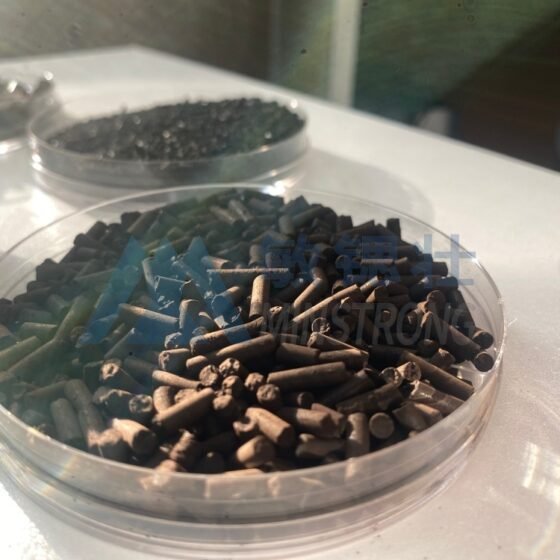
During extrusion or tableting, add a small amount of inorganic binder, such as silica sol or alumina sol. This can raise the crushing strength above 60 N/cm without greatly reducing surface area. Control the particle size to about 3‑5 mm diameter and 3‑8 mm length. This optimizes both bed pressure drop and resistance to breakage.
At the engineering level, install a drying layer before the catalyst bed. Keep the inlet dew point below ‑20 °C. Also add a dust filter. These steps reduce water vapor and particles that attack active sites. They significantly extend the catalyst’s actual service life.
Özet
Özetle, oxygen vacancies are essential for room‑temperature CO oxidation. Surface area is the main factor that determines the number of these vacancies. But high surface area inevitably weakens mechanical strength and promotes sintering. There is a trade‑off.
To manage this trade‑off, we can optimize pore size distribution (favor mesopores), control the Cu/Mn ratio (2.2:1‑3.5:1), and improve the molding process with binders. Combining these with engineering pretreatment (drying and filtration) preserves active sites while enhancing structural stability.
When choosing a catalyst, technicians should look at the specific operating conditions: nem, sıcaklık, CO concentration, ve gaz akış hızı. Do not blindly pursue the highest surface area. Yerine, select a catalyst with the right balance of surface area and strength for your needs. Only by understanding this balance can you achieve both high efficiency and long life in practical applications.
yazar: Gloria
tarih:2026/4/23
WeChat
QR Kodunu WeChat ile tarayın