 Катализаторҳои силсилаи Minslite барои бартараф кардани озон/CO/VOC
Муқаддима
Hopcalite catalysts most typically catalyze carbon monoxide (CO) oxidation. They convert CO into carbon dioxide (CO₂). They do not simply adsorb or store the pollutant. Traditional Hopcalite catalysts contain copper and manganese mixed oxides. They can oxidize CO at relatively low temperatures. Аммо, the name “Хопкалит” alone does not determine treatment capacity. Formulation, намӣ, таркиби газ, ҳарорат, суръати ҷараёни ҳаво, and contact time all influence performance. For other target gases, such as ozone or volatile organic compounds (VOCs), do not rely on the term “Hopcalite.” Evaluate the specific formulation and empirical test data instead.
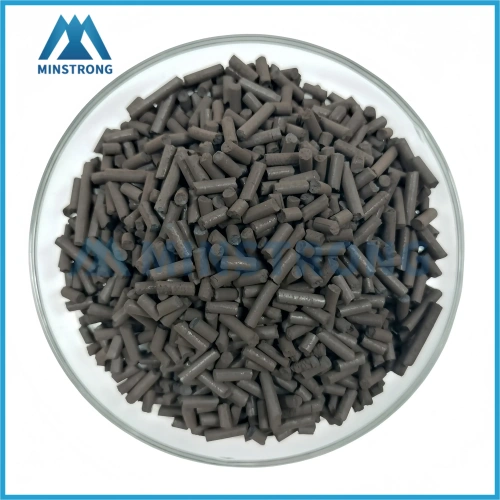
Хопкалит
1. What Gases Do Hopcalite Catalysts Primarily Treat?
1.1 Carbon Monoxide (CO) as the Primary Target
Hopcalite catalysts represent a class of copper-manganese mixed oxide materials. Manufacturers have long used them for low-temperature catalytic oxidation of CO. They also serve in various air purification applications. Their core function is to promote a reaction between CO and oxygen. This reaction converts toxic CO into CO₂, which has much lower toxicity. This process does not eliminate carbon. It changes its chemical form. Бинобар ин, when using Hopcalite in enclosed spaces or personal protective equipment (PPE) systems, consider CO concentrations. Also consider potential CO₂ accumulation, ventilation conditions, and overall air quality.
1.2 Can Hopcalite Decompose Ozone?
Some copper-manganese mixed oxide materials can decompose ozone. Аммо, not all Hopcalite products remove ozone stably and effectively. Ozone decomposition performance depends on active components, surface properties, manufacturing process, and operating environment. Suppose you need to treat exhaust from ozone generators, ozone-based water treatment systems, or ozone-containing gas streams in electronics manufacturing. In that case, prioritize catalysts specifically designed for ozone decomposition. Test a specific Hopcalite formulation for ozone concentration, treatment efficiency, устувории амалиёт, ва мӯҳлати хидмат. Only then can you determine its suitability.
1.3 Can Hopcalite Treat Volatile Organic Compounds (VOCs)?
VOCs are not a single substance. They are a collection of compounds with diverse chemical structures and reaction characteristics. Oxidation difficulty, reaction pathways, and catalytic requirements vary significantly among substances. Бинобар ин, do not assume Hopcalite can treat all VOCs. Certain copper-manganese oxide systems may catalyze specific organic compounds under defined conditions. Аммо, verify actual efficacy for each target substance. If the waste gas contains a complex mixture of organic components, halogenated compounds, sulfides, or other potential interferents, evaluate byproduct formation risks. Also evaluate catalyst deactivation risks and downstream treatment requirements.
2. How Do Hopcalite Catalysts Remove Carbon Monoxide?
2.1 The Fundamental Reaction of Catalytic Oxidation
The fundamental reaction for catalytic CO oxidation is:
2CO + O₂ → 2CO₂
In this process, gas molecules contact the catalyst surface. They undergo adsorption and surface reactions. They ultimately form CO₂, which then desorbs from the surface. The catalyst provides active surface sites. These sites facilitate the reaction and lower the energy barrier. The catalyst does not act as a reactant.
2.2 Why Do Copper-Manganese Composite Oxides Show Catalytic Activity?
The catalytic performance of Hopcalite closely links to interactions between copper and manganese species. Material composition, crystalline phase, surface active oxygen, майдони мушаххаси рӯизаминӣ, and preparation conditions influence CO and oxygen adsorption and conversion. Дар натича, two materials that both carry the Hopcalite name may show different catalytic activity. Raw material ratios, manufacturing processes, heat treatment conditions, and pore structures cause these differences. When evaluating such materials, do not rely solely on the name or a single physicochemical metric. Focus instead on actual catalytic performance under specified operating conditions.
3. What Factors Affect Hopcalite Treatment Efficiency?
3.1 Humidity Is a Critical Operational Factor
Water vapor may compete with reactants for adsorption sites on the catalyst surface. This competition affects the CO oxidation process. Traditional Hopcalite catalysts are sensitive to humidity. Their activity may decline in damp environments. Аммо, moisture resistance varies with formulation and preparation method. Бинобар ин, do not generalize test results for one material to all products. When selecting a catalyst, document inlet relative humidity, ҳарорат, and potential condensation. Conduct tests under conditions as close as possible to the actual operating environment. If the application environment has significant humidity fluctuations, evaluate the catalyst’s ability to recover activity after such changes.
3.2 Gas Flow Rate and Contact Time Influence Reaction Extent
Assume constant catalyst quantity and other fixed conditions. An increase in gas flow rate typically shortens effective contact time between gas and catalyst. This may reduce single-pass conversion rate. Engineering design must account for inlet CO concentration, gas flow volume, catalyst bed dimensions, боркунии катализатор, and system pressure drop. Do not determine processing capacity solely from catalyst mass or volume. Also, do not directly equate removal rates from small-scale, low-flow laboratory tests with actual system performance. Actual systems may operate under high-flow conditions or fluctuating concentrations.
3.3 Temperature and Gas Composition Affect Catalytic Performance
Temperature influences surface reaction rates. Аммо, higher temperatures are not necessarily better. Determine the optimal temperature range from catalyst formulation, target conversion rate, and long-term stability. Improper thermal treatment can alter material structure and activity. Дар Илова, sulfides, чанг, oil mists, and other impurities can cover active sites. They can cause catalyst poisoning, clogging, or deactivation. For gas streams with complex compositions, analyze contaminants first. Then determine whether you need pre-treatment or other purification measures.
3.4 Suitable Applications for Hopcalite
Hopcalite can serve in certain air purification systems for catalytic CO oxidation. Барои намуна, it may reduce CO concentrations in air purification equipment. Such equipment serves mine rescue capsules, emergency refuge chambers, and other specialized occupied spaces. Аммо, such applications involve human life safety. Бинобар ин, validate the entire system—including catalyst, air ducts, мухлисон, and monitoring equipment. Do not rely solely on test results from catalyst samples to determine system safety. In industrial exhaust gas treatment, first identify target gases and their concentrations, намӣ, ҳарорат, flow rates, and co-existing impurities. If the primary objective is ozone decomposition, generally prioritize specialized ozone-decomposition catalytic materials. If the goal is treatment of complex VOCs, select the appropriate technical approach based on specific organic composition. Determine whether a Hopcalite-type catalyst suits these scenarios by targeted performance data. Do not infer suitability simply from the material category.
4. How to Select the Right Hopcalite Catalyst?
4.1 Define Target Gases and Treatment Requirements
Before selection, clearly define the types of gases to remove. Define inlet concentrations, target outlet concentrations, airflow rates, and continuous operation requirements. If multiple pollutants are present, assess potential competitive adsorption, inter-pollutant reactions, or catalyst poisoning.
4.2 Validate Catalytic Performance Under Actual Operating Conditions
Conduct tests under representative conditions. Account for temperature, намӣ, суръати ҷараёни, and gas composition. Focus on CO conversion rates, outlet concentrations, operational duration, and performance degradation trends. For high-risk applications, such as those in enclosed spaces, also verify system performance during startup. Verify performance during gas concentration fluctuations and abnormal operating conditions.
4.3 Consider Service Life, Pressure Drop, and Maintenance
Initial catalytic activity does not equal long-term operational performance. Particle size, loading method, dust accumulation, and mechanical strength affect performance. Airflow distribution across the catalyst bed also matters. Engineering selection should also account for replacement cycles, monitoring methods, талаботи нигоҳдорӣ, and proper disposal of spent catalytic materials.
5. Precautions for Using Hopcalite Catalysts
Аввал, avoid using unvalidated materials in safety-critical applications. Дуюм, remain vigilant regarding factors that may cause performance degradation. These factors include high humidity, sulfur-containing impurities, and dust. Establish a routine schedule for testing and catalyst replacement. Дар охир, distinguish between the removal capacity of the catalyst itself and the overall treatment capability of the purification system. A catalyst may meet performance specifications. Аммо, that does not guarantee the system will achieve desired results under all operating conditions. For CO purification, remember that catalytic oxidation produces CO₂. Бинобар ин, the overall system design must account for available space, number of occupants, ventilation, and gas monitoring.
Хулоса
In general, the most definitive and representative application for Hopcalite catalysts is catalytic CO oxidation. Evaluate their effectiveness in treating other substances—such as ozone or VOCs—on a case-by-case basis. This evaluation depends on the specific catalyst formulation and test results for the target pollutants. Select and verify a catalyst based on actual gas composition and specific operating conditions. This is the only reliable way to assess its suitability for a given engineering application.
муаллиф: Глория
сана:2026/10/15
WeChat
Коди QR-ро бо WeChat скан кунед