 Катализаторы серии Minslite для удаления озона/CO/ЛОС
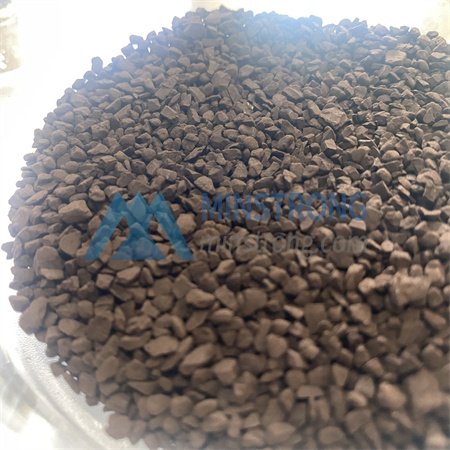
Оксид этилена (ЭО) катализаторы
1. What Is an Ethylene Oxide Catalyst?
Ethylene oxide is a highly reactive organic compound widely encountered in processes such as sterilization and chemical production. Because untreated EO-containing gas cannot simply be discharged, an appropriate treatment process is required to reduce its concentration before emission.
An ethylene oxide catalyst is a functional material designed to accelerate the oxidation of EO without being consumed at the same rate as the reactants. In catalytic treatment systems, EO-containing gas passes through a catalyst bed, where EO molecules interact with active sites on the catalyst surface and undergo a series of oxidation reactions.
The fundamental objective is not merely to capture EO temporarily, but to promote its chemical conversion into more stable products. Under suitable operating conditions, the overall reaction can be represented conceptually as the oxidation of ethylene oxide by oxygen to form carbon dioxide and water.
2. How Does an Ethylene Oxide Catalyst Work?
2.1 EO Adsorption on the Catalyst Surface
The first important step is the contact between EO molecules and the catalyst surface. Industrial catalysts normally contain porous structures that provide a large effective surface area. When EO-containing gas flows through the catalyst bed, EO molecules diffuse toward and interact with active sites.
Adsorption increases the local concentration of reactants around the active sites and places EO in a more favorable chemical environment for subsequent reactions. Поэтому, surface structure, pore characteristics, and active-site distribution can strongly influence catalytic performance.
2.2 Oxygen Activation
Oxidation requires an effective source of oxygen. On a suitable catalyst surface, oxygen molecules can interact with active sites and become more chemically reactive. Depending on the catalyst composition and reaction mechanism, oxygen may participate through adsorbed oxygen species or other surface oxygen intermediates.
The ability to activate oxygen is one of the key factors distinguishing catalytic oxidation from simple gas-phase oxidation. A catalyst can lower the effective energy barrier of the reaction, allowing EO oxidation to proceed at temperatures lower than those generally required for direct thermal oxidation.
2.3 Surface Oxidation and Bond Transformation
After EO and activated oxygen are present on the catalyst surface, a sequence of surface reactions takes place. The catalyst facilitates the cleavage and rearrangement of chemical bonds within the EO molecule while promoting its reaction with oxygen-containing species.
This process should be understood as a multi-step surface reaction rather than a single instantaneous reaction. The exact intermediate species depend on the catalyst composition, surface oxidation state, температура, and reaction environment. Properly designed catalysts accelerate these elementary reactions while maintaining sufficient active-site availability.
2.4 Formation of CO₂ and H₂O
As oxidation proceeds, the carbon and hydrogen contained in EO are progressively converted into more stable oxidation products. Under appropriate catalytic conditions, the desired final products are mainly carbon dioxide and water.
This complete-oxidation pathway is particularly important in industrial waste-gas treatment because the purpose of catalytic oxidation is to destroy EO chemically rather than simply transfer it from the gas phase to another material.
3. Why Can Catalytic Oxidation Operate at Relatively Low Temperatures?
Direct oxidation of EO requires sufficient thermal energy to overcome the reaction activation barrier. A catalyst changes the reaction pathway by providing active sites where reactants can be adsorbed, activated, and transformed through lower-energy intermediate steps.
Следовательно, catalytic oxidation can often achieve effective EO conversion at relatively lower temperatures than direct thermal oxidation. Lower operating temperatures may reduce energy consumption and simplify the design of downstream treatment equipment.
Однако, “low-temperature operation” should not be interpreted as meaning that every EO catalyst performs effectively at any low temperature. The required operating temperature must be determined according to catalyst properties, EO concentration, газовый состав, пространственная скорость, and the required removal efficiency.
4. What Factors Affect EO Catalyst Performance?
4.1 Catalyst Composition and Active Sites
The chemical composition and oxidation-reduction properties of the catalyst directly affect oxygen activation and EO oxidation. A catalyst with suitable active sites can provide faster reaction kinetics and better conversion under the same operating conditions.
4.2 Temperature and Gas Residence Time
Temperature influences reaction kinetics, while residence time determines how long EO-containing gas remains in contact with the catalyst. Excessively high gas velocity may shorten contact time and reduce conversion, whereas an appropriately designed flow rate can improve the utilization of the catalyst bed.
4.3 Humidity and Other Gas Components
Water vapor and coexisting compounds may compete for catalyst surface sites or alter surface oxygen species. Depending on the catalyst system, high humidity may therefore affect EO conversion. Other organic compounds, sulfur-containing substances, particulate matter, or catalyst poisons may also influence long-term activity.
4.4 Catalyst Structure and Mass Transfer
Catalytic performance depends not only on chemical activity but also on mass transfer. Gas must reach the active sites efficiently, and reaction products must leave the catalyst surface. Поэтому, пористая структура, размер частиц, механическая прочность, падение давления, and catalyst-bed design should all be considered in an industrial system.
5. How Should an EO Catalytic Oxidation System Be Evaluated?
Для промышленного применения, catalyst selection should not rely on a single activity value. A comprehensive evaluation should consider EO conversion efficiency, рабочая температура, пространственная скорость, падение давления, mechanical stability, resistance to humidity and contaminants, long-term activity, and regeneration or replacement requirements.
Testing should also reproduce the actual process conditions as closely as possible. EO concentration, oxygen concentration, влажность, расход газа, температурный диапазон, and coexisting pollutants can significantly influence the observed catalytic performance. Laboratory results obtained under idealized conditions may not directly represent industrial operation.
6. Key Takeaways for Industrial EO Treatment
The working principle of an ethylene oxide catalyst can be summarized as EO adsorption → oxygen activation → surface oxidation → formation of CO₂ and H₂O. The catalyst accelerates these reactions by providing suitable active sites and a more favorable reaction pathway.
For practical EO waste-gas treatment, the most important consideration is therefore not simply whether a catalyst can oxidize EO, but whether it can maintain the required conversion efficiency under the actual temperature, влажность, газовый состав, скорость потока, and long-term operating conditions. Understanding the reaction mechanism provides the basis for selecting and designing a catalytic oxidation system that is technically appropriate for a specific industrial process.
автор:кака
дата:2026/8/13
Вичат
Сканируйте QR-код с помощью WeChat