 Catalisadores da série Minslite para remoção de ozônio/CO/COVs
Monóxido de carbono (CO) é um gás tóxico. As indústrias costumam produzi-lo em processos de combustão. A oxidação catalítica é a maneira mais eficiente de remover CO. Os óxidos compostos de cobre-manganês estão entre os melhores catalisadores para esta tarefa. Seu desempenho depende de um delicado equilíbrio entre abundância de sítios ativos e estabilidade estrutural.
Este artigo explica esse equilíbrio. Abrange quatro tópicos: a natureza dos sites ativos, os prós e contras da alta área de superfície, as causas da deterioração do catalisador, e estratégias para otimizar a atividade e a expectativa de vida.
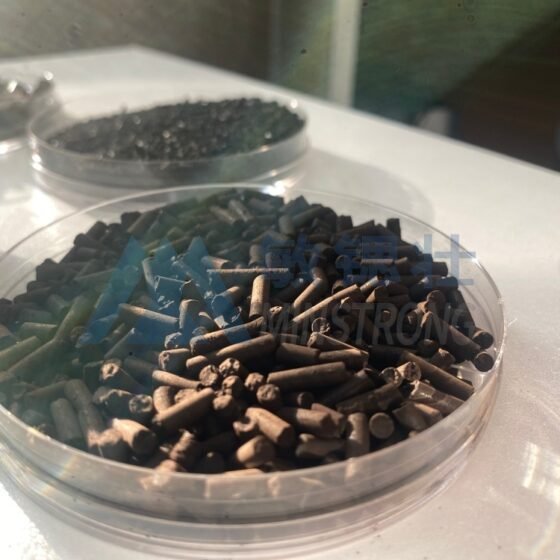
Catalisadores de Monóxido de Carbono
Sites ativos: Vagas de oxigênio e sinergia cobre-manganês
A atividade catalítica não se espalha uniformemente por toda a superfície. Ele se concentra em defeitos específicos chamados vagas de oxigênio. Estes são pontos onde faltam átomos de oxigênio na rede cristalina. As vagas de oxigênio podem adsorver moléculas de CO. Eles também servem como locais onde o O₂ se divide em átomos reativos de oxigênio..
Em óxidos de cobre-manganês, cobre e manganês trabalham juntos. O cobre adsorve CO através de mudanças em seu estado de valência (Cu⁺/Cu²⁺). O manganês fornece oxigênio ativo através de seu próprio ciclo redox (Mn³⁺/Mn⁴⁺). Esta sinergia aumenta o poder das vagas de oxigênio. Reduz a energia de ativação para oxidação de CO de cerca de 80-100 kJ/mol para 30-50 kJ/mol. Como resultado, a reação prossegue rapidamente à temperatura ambiente (0-40 °C).
O número de sites ativos afeta diretamente a atividade inicial. Mais vagas de oxigênio por grama geralmente significam maior conversão de CO. No entanto, esses locais fazem parte da estrutura cristalina do catalisador. A estrutura deve permanecer estável ao longo do tempo. Se o quadro enfraquecer, os sites perdem sua atividade. Esta é a raiz do compromisso entre a área de superfície e o tempo de vida.
Alta área de superfície: Uma espada de dois gumes

Uma alta área de superfície específica é fundamental para a oxidação de CO à temperatura ambiente. Quando a área atingir 180‑240m²/g, o catalisador forma uma densa rede de microporos (abaixo de 2nm) e mesoporos (2-50nm). Esta rede expõe muitos sites ativos por unidade de massa. Sob seco, condições limpas (umidade relativa abaixo de 10%), tais catalisadores podem converter mais de 95% de CO em uma única passagem. Eles funcionam bem em velocidades espaciais de 3.000-80.000/h.
Mas a elevada área superficial também traz pontos fracos. Primeiro, muitos microporos reduzem a resistência mecânica. A resistência média ao esmagamento pode cair abaixo de 45N/cm. Isso torna as partículas propensas a quebrar sob o fluxo de ar. Segundo, alta área superficial significa que mais átomos superficiais são insaturados. Esses átomos migram e se agregam em altas temperaturas ou em calor úmido. Esta sinterização desativa os sites. Terceiro, muitos microporos retardam a difusão do gás. Em altas velocidades espaciais, a resistência à difusão interna aumenta, reduzindo a eficiência aparente.
Portanto, uma área de superfície maior nem sempre é melhor. Deve corresponder às condições reais de operação: velocidade espacial, temperatura, e níveis de impurezas.
Por que os catalisadores se degradam: Envenenamento, Sinterização, e quebra
A deterioração do catalisador em aplicações reais vem de três causas principais. Muitas vezes eles acontecem juntos.
Envenenamento de locais ativos
O vapor de água é o veneno mais comum. As moléculas de água ligam-se fortemente às vagas de oxigênio através de ligações de hidrogênio.. Eles bloqueiam a adsorção de CO, causando desativação reversível. Quando a umidade de entrada excede 10-15%, conversão cai drasticamente. Acima de 45% de umidade por longos períodos, pode ocorrer desativação irreversível devido à condensação capilar. Compostos de enxofre (como H₂S e SO₂) e as olefinas reagem irreversivelmente com os componentes ativos. Estes destroem permanentemente sites ativos.
Sinterização Térmica
Ao tratar altas concentrações de CO (mais de 5% em volume), a reação exotérmica pode aquecer a cama repentinamente. Isso é chamado de fuga. Em altas temperaturas, grãos de óxido de cobre-manganês crescem. A área de superfície específica cai rapidamente, e as vagas de oxigênio se fundem e desaparecem. Depois de esfriar, o catalisador sinterizado não consegue recuperar sua atividade.
Quebra Mecânica
Catalisadores fracos se decompõem gradualmente sob fluxo de ar e mudanças de temperatura de longo prazo. Eles produzem pó fino. Este pó entope a cama, aumenta a queda de pressão, e reduz a massa efetiva de sites ativos. Esses três mecanismos geralmente funcionam juntos. Por exemplo, o gás úmido não apenas envenena locais, mas também acelera a sinterização hidrotérmica.
Como Alcançar o Equilíbrio: Três estratégias principais
Para equilibrar a área de superfície e a vida útil, podemos usar três abordagens principais.
Otimize a distribuição do tamanho dos poros
Não vise apenas a área de superfície máxima. Em vez de, projetar uma estrutura de poros que favoreça os mesoporos (2-50nm). Estudos mostram que catalisadores com muitos mesoporos mantêm uma área superficial elevada, ao mesmo tempo que oferecem melhor difusão de gás e propriedades mecânicas mais fortes do que materiais microporosos. Um catalisador ideal possui um sistema hierárquico de poros: microporos fornecem vagas de oxigênio, mesoporos permitem o transporte de gás, e macroporos (acima de 50nm) reduzir a queda de pressão do leito. Controlando a quantidade de agente formador de poros durante a preparação, podemos ajustar a proporção de mesoporos para exceder 50% do volume total de poros.
Controle a proporção molar cobre-manganês
Manter o Cu:Razão molar Mn entre 2.2:1 e 3.5:1. Dentro deste intervalo, o catalisador forma uma fase de espinélio estável (CuMn₂O₄) ou solução sólida. Esta estrutura resiste melhor à sinterização do que simples óxidos mistos. Excesso de um metal (geralmente manganês) atua como promotor estrutural, inibindo o crescimento de grãos em altas temperaturas. Esta proporção garante vagas de oxigênio suficientes, mantendo a rede estável.
Melhore o processo de moldagem e adicione pré-tratamento
Durante a extrusão ou compressão, adicione uma pequena quantidade de aglutinante inorgânico, como sol de sílica ou sol de alumina. Isto pode aumentar a resistência ao esmagamento acima de 60N/cm sem reduzir significativamente a área de superfície. Controle o tamanho das partículas para cerca de 3-5 mm de diâmetro e 3-8 mm de comprimento. Isso otimiza a queda de pressão do leito e a resistência à quebra.
No nível de engenharia, instale uma camada de secagem antes do leito catalítico. Mantenha o ponto de orvalho de entrada abaixo de -20°C. Adicione também um filtro de poeira. Estas etapas reduzem o vapor de água e as partículas que atacam os locais ativos. Eles prolongam significativamente a vida útil real do catalisador.
Resumo
Resumindo, as vagas de oxigênio são essenciais para a oxidação do CO à temperatura ambiente. A superfície é o principal fator que determina o número dessas vagas. Mas a alta área superficial enfraquece inevitavelmente a resistência mecânica e promove a sinterização. Há uma compensação.
Para gerenciar essa compensação, podemos otimizar a distribuição do tamanho dos poros (favorece os mesoporos), controlar a relação Cu/Mn (2.2:1-3,5:1), e melhorar o processo de moldagem com ligantes. Combinando estes com pré-tratamento de engenharia (secagem e filtração) preserva locais ativos enquanto melhora a estabilidade estrutural.
Ao escolher um catalisador, os técnicos devem observar as condições operacionais específicas: umidade, temperatura, Concentração de CO, e taxa de fluxo de gás. Não persiga cegamente a área de superfície mais alta. Em vez de, selecione um catalisador com o equilíbrio certo entre área de superfície e resistência para suas necessidades. Somente compreendendo esse equilíbrio você poderá alcançar alta eficiência e longa vida útil em aplicações práticas.
autor: Glória
data:2026/4/23
WeChat
Digitalize o código QR com WeChat