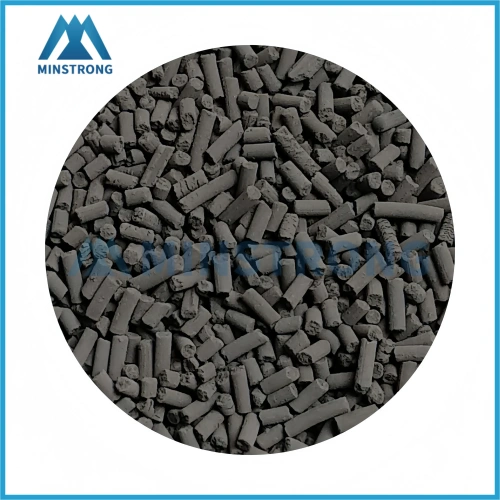
 오존/CO/VOC 제거용 Minslite 시리즈 촉매
Spray-paint exhaust still requires VOCs catalytic oxidation after filtration. This is not because filtration efficiency is insufficient. The two processes handle pollutants with fundamentally different physical forms. A filtration unit captures paint mist particles and droplets from the gas stream. Under proper operation, it removes 85%–95% of particulate matter. Gaseous VOCs, 하지만, exist as molecules. They pass directly through filter media. Filtration causes no measurable chemical conversion of these gases.
A filtration-only system may keep particulate matter within limits at the stack. Yet non-methane hydrocarbons and characteristic BTEX compounds often remain at their original levels. A complete treatment train needs two complementary functions. 첫 번째, pretreatment reduces particulate matter and catalyst poisons to levels the catalytic unit can tolerate. 두번째, catalytic oxidation converts gaseous organics into CO₂ and H₂O over a catalyst at relatively low temperatures. Filtration addresses whether particulate matter can be captured; catalytic oxidation addresses whether organics can be destroyed. They operate on different scales and cannot replace each other.
Paint mist and gaseous VOCs are two separate treatment targets
Spray painting emits pollutants that fall into at least two categories. Overspray forms paint mist particles and droplets in the gas stream. They consist mainly of resins, pigments, and solvents. These particles fall into the particulate category. Dry filters, water curtains, or scrubbers can intercept them. The other category is gaseous VOCs, such as benzene, toluene, xylene, 에스테르, 케톤, and alcohols. Solvents and thinners evaporate continuously during spraying, flash-off, and curing to generate these gases. Their molecular scale is orders of magnitude smaller than that of paint mist particles.
This difference in physical form means treatment metrics cannot substitute for one another. Engineers evaluate paint mist control by particulate concentration and filter pressure drop. They evaluate VOCs control by the removal efficiency of non-methane hydrocarbons and characteristic components. Relevant standards set separate limits for particulate matter and VOCs. This confirms that they are parallel compliance indicators. Interpreting paint mist filtration efficiency as VOCs treatment performance skips the removal step for gaseous pollutants in logic.
Filtration protects downstream units; it does not purify gaseous organics
Engineers must evaluate filtration based on its effect on downstream equipment, not as a VOCs removal unit. Paint mist particles are tacky. If they enter adsorbent materials or a catalyst bed, they cover active sites, block pores, and form carbon deposits on the catalyst surface. Technical specifications require operators to apply filtration or scrubbing pretreatment first when particulate matter in exhaust exceeds 1 mg/m3. Gas entering a catalytic combustion unit must also be free of dust particles and droplets. This prevents catalyst bed plugging and catalyst poisoning.
Filtration performs a phase transfer of pollutants. It retains particulate matter on filter media or in scrubber liquid. It does not reduce the number of VOCs molecules in the gas phase. Catalytic oxidation performs chemical conversion. Organics react with oxygen on the catalyst surface. This fully oxidizes the carbon skeleton into CO₂ and H₂O. The former is physical interception; the latter is chemical decomposition. Plant operators frequently change filters, yet non-methane hydrocarbon measurements remain high. This happens precisely because physical interception cannot reach molecular-scale gaseous pollutants.
The engineering value of catalytic oxidation is lower reaction temperature, but that advantage depends on catalyst activity
Spray-paint exhaust typically has high flow and low-to-moderate concentration. Direct combustion of toluene requires about 800°C for complete oxidation. At such temperatures, NO₂ formation can cause secondary pollution. Catalytic combustion only needs 220–300°C for complete oxidation. This downward shift in temperature range makes deep purification of low-to-moderate-concentration VOCs energy-feasible.
But the temperature advantage is not unconditional. Catalytic reaction requires gaseous organics to reach active sites on the catalyst surface. They must convert within the design space velocity and temperature window. For toluene at 2,000 mg/m3, a noble metal catalyst reaches light-off at 243°C. It needs only 249°C for 90% 변환, a difference of just 6°C. When toluene concentration rises to 12,000 mg/m3, light-off drops further to 223°C. This means engineers must design the catalytic unit to find a window between conversion and catalyst life, not simply to run at higher temperature. Engineering data also show that typical operating temperatures for spray-paint exhaust catalytic combustion units fall in the 250–350°C range. Catalyst design life generally exceeds 8,000 시간.
Catalysts span a wide performance range; “catalytic oxidation” is not a single answer
“VOCs catalyst” is a material category, not a product with fixed performance. Noble metal catalysts and non-noble metal catalysts differ in low-temperature activity and thermal stability. These differences directly affect whether the catalytic unit can operate stably within the temperature window of spray-paint exhaust.
A comparative study used toluene as the model reactant. It provides useful reference data. After researchers treated the catalyst at 600°C for 3 시간, the toluene light-off temperature over a non-noble metal catalyst was 50°C higher than over a noble metal catalyst. After treatment at 900°C for 3 시간, the noble metal catalyst’s light-off temperature rose only 3°C compared with the 600°C treatment. The non-noble metal catalyst’s light-off temperature rose by 87°C. Spray-paint exhaust composition fluctuates with coating changes, and localized overheating can occasionally occur. This comparison shows that low-temperature activity and thermal stability of the catalyst are coupled. Initial light-off temperature alone cannot serve as the basis for selection. Noble metal catalysts offer a wider engineering window for deep purification of coating exhaust due to their combined low-temperature activity and resistance to high-temperature degradation. Engineers must evaluate non-noble metal catalysts for applicability based on specific formulation and operating-condition matching.
Catalyst life is often limited not by activity but by intrusion of paint mist and impurities
The actual life of a catalyst in spray-paint exhaust depends largely on how non-target components in the exhaust attack it. It depends less on its initial activity toward target VOCs. The first pathway is physical coverage and carbon deposition. Resin components in paint mist and carbonaceous deposits from incomplete reaction accumulate on the catalyst surface. They cover active sites and block pores. In the spray-painting industry, cases of paint-mist resin accelerating carbon deposition show catalyst bed pressure drop rising by 300 Pa within one week. This forces a shutdown for cleaning. This failure has little to do with catalyst chemical composition. The root cause is inadequate control of tacky particles in the pretreatment stage.
The second pathway is 화학 중독. 황, 염소, 인, and other elements in the exhaust can react with active components. This forms catalytically inactive compounds. Untreated sulfur-containing exhaust can shorten catalyst life from 2 년 ~ 3 개월. Chlorine-containing thinners can cause catalyst activity to decay by 60% 이내에 3 개월. Sulfur and halogen sources can come from coating formulations, pretreatment steps, or cleaning solvents. Their concentrations may be low. But continuous exposure causes cumulative effects that engineers cannot ignore. Operators can partially restore physical coverage by purging or regeneration. 화학 중독, 하지만, is often irreversible. This also explains why specifications require that organic concentration entering the catalytic oxidation reactor be below 25% of the lower explosive limit (LEL). They also require pretreatment to control particulate matter and catalyst poisons entering the catalyst bed.
An engineered configuration requires coordinated design of pretreatment precision and catalytic parameters
Putting this logic into an engineering configuration reveals that a typical spray-paint exhaust catalytic oxidation process is not a simple series of “filtration followed by catalysis.” One metal coating exhaust treatment case used a dry baghouse, zeolite rotor concentrator, and rotary regenerative catalytic oxidizer process. Rotor desorption occurred at 170–180°C, and catalytic combustion occurred at 400°C. 후에 3 운영 개월, catalytic conversion remained stable at 97%, and system VOCs removal efficiency remained above 90%. This case relied on a critical prerequisite: the dry baghouse. It separated particulate matter and paint mist before they entered the rotor and catalyst bed. The zeolite rotor then concentrated VOCs in a relatively clean gas phase. Only under these conditions could the catalytic unit maintain reproducible conversion at the set temperature. Upstream particulate control failure will damage both adsorbent capacity and catalyst active sites simultaneously. Subsequent efficiency metrics then lose any stable, reproducible basis.
Filtration and catalysis are not competitors. This is not a case where “filtration meeting limits means catalysis can be omitted.” Filtration separates paint mist particles from the gas phase. It provides the catalytic unit with an inlet condition suitable for long-term operation. Catalytic oxidation converts gaseous VOCs to CO₂ and H₂O over a catalyst. If engineers neglect either end, the engineering value of the other cannot stand independently.
For a specific project, engineers should follow a rational sequence. 첫 번째, identify the main VOCs components and paint mist load in the exhaust. 두번째, confirm whether pretreatment can reduce particulate matter and catalyst poisons to tolerable levels for the catalyst. 제삼, select the catalyst type, 공간 속도, and temperature window based on the reactivity of target components and the range of operating fluctuations. Minstrong provides VOCs catalyst selection evaluation and lab/pilot-scale validation support. We focus on the composition characteristics and operating conditions of spray-paint exhaust. This helps translate these judgments into executable parameters.
작가:글로리아
날짜:2026-10-19
위챗
WeChat으로 QR 코드를 스캔하세요