 Katalis Seri Minslite untuk Penghapusan Ozon/CO/VOC
Ozone is a strong oxidant. Industries commonly use it in water treatment, pengolahan gas buang, manufaktur semikonduktor, and medical disinfection. Namun, ozone itself is also an air pollutant. If residual ozone in industrial exhaust discharges without treatment, it violates environmental regulations. Lebih-lebih lagi, it harms equipment, human health, and the ecosystem. Karena itu, ozone off‑gas destruction becomes an indispensable step in these processes.
Among the various ozone off‑gas treatment technologies, dekomposisi katalitik stands out. In fact, it is the most widely applied and lowest‑cost route in industrial ozone abatement. This method efficiently converts ozone into oxygen at room temperature. Secara khusus, room‑temperature catalytic decomposition technology uses Mn‑based catalysts. These catalysts lower the activation energy of the ozone decomposition reaction. Sebagai akibat, the reaction proceeds efficiently at ambient temperature and pressure. Lebih-lebih lagi, the catalyst can be reused, which greatly reduces treatment costs. Its small footprint also makes it easy to integrate into various equipment.
This article systematically analyzes how room‑temperature catalytic decomposition technology reduces industrial operating costs. It covers four key aspects: energy consumption, pemeliharaan peralatan, catalyst lifetime, and ozone utilization efficiency.
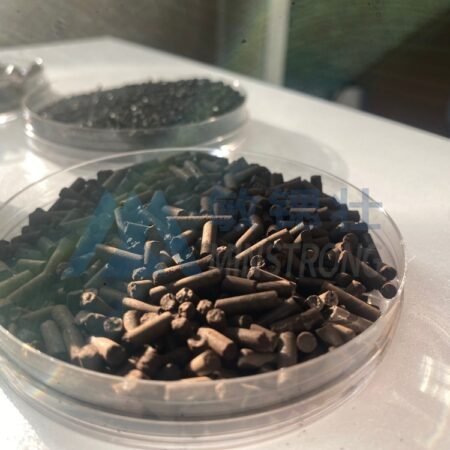
Katalis pengurai ozon
1. Energy Cost: Dari “High Energy Consumption” ke “Near‑Zero Energy Consumption”
The main industrial methods for ozone off‑gas treatment include activated carbon adsorption, dekomposisi termal, dan dekomposisi katalitik. Pertama, dekomposisi termal was an early common approach. It heats the ozone‑containing gas to 300 °C to 400 °C. This provides sufficient energy for ozone molecules to decompose. When heated to 350 °C, the half‑life of ozone is less than 0.04 seconds. Akibatnya, complete decomposition can be achieved within 1.5 ke 2 seconds. Although this method has high decomposition efficiency, it consumes enormous energy. It also requires specialized heating equipment and thermal insulation. This results in high operating costs. For industrial production lines that operate 24/7, the electricity or fuel costs for heating alone represent a significant long‑term expense.
Kedua, activated carbon adsorption uses the porous structure of activated carbon to adsorb ozone molecules. Selama proses ini, ozone chemically reacts on the surface to decompose into oxygen. Namun, the adsorption capacity of activated carbon is limited. In fact, its efficiency drops sharply under high‑humidity and high‑ozone‑concentration conditions. Once saturated, it requires regeneration or replacement. This, in turn, meningkatkan biaya pengoperasian dan kompleksitas pemeliharaan.
Ketiga, dekomposisi katalitik pada suhu kamar pada dasarnya berbeda. Misalnya, Katalis berbasis Mn dapat menguraikan ozon menjadi oksigen jika bersentuhan dengan gas yang mengandung ozon pada suhu kamar atau suhu rendah. Lebih-lebih lagi, mereka tidak memerlukan sumber cahaya atau kondisi eksternal lainnya. Teknologi ini beroperasi pada suhu ruangan atau rendah. Sebagai akibat, itu menghemat energi, dan biaya operasionalnya hampir nol. Karena itu, dengan mengadopsi dekomposisi katalitik suhu kamar, perusahaan dapat sepenuhnya menghilangkan pembelian, instalasi, energi yang berkelanjutan, dan biaya pemeliharaan peralatan pemanas. Untuk pabrik industri berukuran sedang, hal ini saja dapat menghemat biaya energi ratusan ribu hingga jutaan yuan setiap tahunnya.
2. Biaya Peralatan dan Perawatan: Sistem yang Disederhanakan dan Pengurangan Tenaga Kerja
Di luar energi, equipment investment and routine maintenance are also major components of industrial ozone off‑gas treatment.
Di satu sisi, thermal decomposition requires a series of equipment. This includes furnaces, penukar panas, temperature control systems, and insulation materials. Akibatnya, this results in a complex system with a large footprint and high initial investment. Lebih-lebih lagi, long‑term high‑temperature operation leads to component aging and thermal fatigue. These issues require regular inspection and replacement. Maintenance costs therefore remain persistently high.
Di sisi lain, room‑temperature catalytic technology uses catalyst‑packed beds or modular components. This system is simple and requires fewer pieces of equipment. Lebih-lebih lagi, this process does not require any chemical additives or pH adjustment. Itu juga tidak memerlukan operasi manual yang sering, jadi biaya tenaga kerja rendah. Beroperasi pada suhu dan tekanan sekitar, ini tidak membebankan persyaratan ketahanan suhu tinggi khusus pada material peralatan. Alih-alih, ini menghilangkan risiko keselamatan peralatan bersuhu tinggi dan mengurangi investasi dalam perlindungan keselamatan. Dengan teknologi terintegrasi, peralatan yang terlibat sangat minim. Pengoperasiannya nyaman, dan tingkat otomatisasinya tinggi.
3. Masa Pakai Katalis dan Biaya Penggantian
Sebagai bahan habis pakai, masa pakai katalis secara langsung mempengaruhi biaya pengoperasian jangka panjang.
Dekomposisi katalitik pada suhu kamar, siklus penggantian katalis merupakan faktor ekonomi utama. Data aplikasi industri menunjukkan bahwa di bawah suhu dan tekanan sekitar, the catalyst in ozone catalytic oxidation equipment has a replacement cycle of 2 ke 3 bertahun-tahun. There are no maintenance costs in between. This means that companies only need to replace the catalyst every 2 ke 3 bertahun-tahun. Sebagai akibat, they have virtually no additional maintenance outlay during that period.
Lebih-lebih lagi, some catalysts are capable of regenerasi. Catalytic materials can continuously desorb and regenerate during operation. This enables recycling. If activity declines after a certain period, it can be restored by appropriate methods. The application of regeneration technology further extends the effective service life of the catalyst. Akibatnya, this reduces the catalyst cost per unit time.
Dalam seleksi sebenarnya, the annualized cost of catalysts varies significantly. Misalnya, compare two catalysts: Catalyst A costs 2,000 yuan/L and lasts 2 bertahun-tahun. Karena itu, its annualized cost is 1,000 yuan/L·yr. Catalyst B costs 1,000 yuan/L but lasts only 6 bulan. Dengan demikian, its annualized cost is 2,000 yuan/L·yr. Jelas sekali, the cheaper Catalyst B actually has twice the annualized cost of Catalyst A. This demonstrates that focusing solely on initial purchase price while ignoring service life often leads to much higher long‑term expenditures. Selain itu, using a catalyst beyond its useful life can increase the overall system operating cost by more than 30%.
Sebaliknya, thermal decomposition has no catalyst replacement cost. Namun, the accumulated high energy expenditure over 2 ke 3 years far exceeds the one‑time purchase cost of the catalyst. From a life‑cycle cost perspective, room‑temperature catalytic technology has a clear economic advantage.
4. Indirect Cost Savings Through Improved Ozone Utilization
At the source of ozone application, increased ozone utilization also significantly reduces operating costs.
In conventional ozone oxidation processes, a large amount of ozone discharges with the off‑gas without participating in the reaction. This wastes the electricity consumed by the ozone generator. It also increases the burden on tail‑gas treatment. Namun, with efficient catalysts, ozone utilization can dramatically rise from about 30% to over 95%. Higher utilization means that the same ozone production can achieve better treatment results. Alternatively, ozone generation can reduce while maintaining the same treatment performance. This, in turn, lowers the power consumption and size of the ozone generator.
Data show that with ozone catalytic oxidation technology, the ozone dosage per mg/L of COD removed can be below 1.5 mg/L. Lebih-lebih lagi, the short residence time in the catalyst bed significantly reduces the amount of catalyst required and the overall footprint. This efficiency gain translates into notable cost savings over the long term. Misalnya, one engineering practice reported that operating costs decreased by about 15.2% after adopting catalytic ozone oxidation.
5. Comprehensive Cost Comparison and Practical Benefits
Comparing all the above cost factors clearly demonstrates the economic advantages of room‑temperature catalytic decomposition:
| Cost Item | Dekomposisi Termal | Room‑Temp Catalytic Decomposition |
|---|---|---|
| Energy Consumption | Tinggi (continuous heating at 300–400 °C) | Very low (operating cost nearly zero) |
| Equipment Investment | Tinggi (tungku, penukar panas, insulation systems, dll.) | Low (catalyst bed or modular components) |
| Maintenance Cost | Tinggi (regular overhaul of high‑temp equipment) | Low (maintenance‑free for 2–3 years) |
| Labor Cost | Moderate | Low (infrequent operations) |
| Safety Investment | Tinggi (high‑temperature protection) | Low (ambient‑temperature operation) |
Taking the semiconductor industry as an example, the annual market demand for ozone off‑gas treatment in this sector alone is around 2 billion yuan. As environmental regulations on ozone emission limits continue to tighten, this market continues to grow. Akibatnya, room‑temperature catalytic decomposition technology, with its comprehensive advantages of “konsumsi energi mendekati nol, maintenance‑free operation, dan umur panjang,” is becoming the preferred solution for an increasing number of industrial enterprises.
Kesimpulan
Singkatnya, room‑temperature catalytic ozone decomposition technology systematically reduces industrial operating costs in ozone off‑gas treatment through multiple pathways: eliminating high‑temperature heating, simplifying equipment systems, memperpanjang siklus penggantian katalis, dan meningkatkan pemanfaatan ozon. Untuk perusahaan industri yang mengupayakan kepatuhan lingkungan dan pengurangan biaya, tidak diragukan lagi ini merupakan jalur teknologi yang memberikan manfaat lingkungan dan ekonomi. Seiring dengan semakin matangnya teknik preparasi katalis dan skala produksi yang semakin meluas, biaya penerapan dekomposisi katalitik suhu kamar akan semakin menurun. Akhirnya, hal ini akan memberikan solusi pengurangan ozon yang layak secara ekonomi untuk skenario industri yang lebih luas.
pengarang: Gloria
tanggal:2026/6/17
Wechat wechat
Pindai Kode QR dengan WeChat