 Minslite Series Catalysts for Ozone/CO/VOCs Removal
The selection of an ozone decomposition catalyst should be based on actual operating conditions rather than only catalyst type or initial activity. Factors such as ozone concentration, humidity, temperature, gas flow rate, and application environment directly influence catalytic efficiency and service life.
For low-concentration ozone removal under humid conditions, catalysts with strong moisture resistance and long-term stability are generally preferred. For high-concentration ozone treatment, catalysts with high catalytic activity, strong oxidation resistance, and stable structures are more suitable. A proper selection process can improve ozone removal efficiency while reducing maintenance frequency and operating costs.
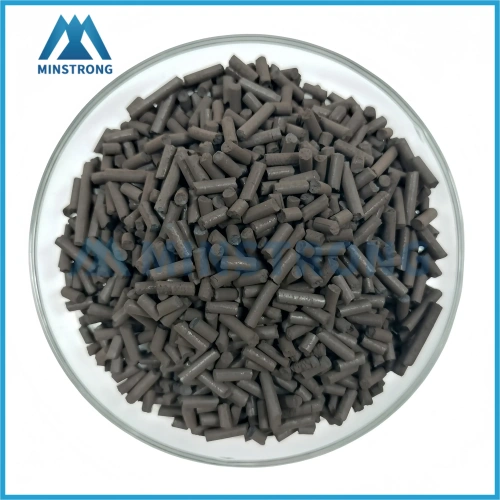
ozone decomposition catalyst
Why Operating Conditions Determine Ozone Decomposition Catalyst Selection
Ozone decomposition catalysts are widely used to convert ozone (O₃) into oxygen (O₂) through catalytic reactions, reducing residual ozone emissions from industrial processes. Although the basic reaction principle is similar across different applications, actual operating environments vary significantly.
For example, ozone generated from industrial ozone systems may have different concentrations and gas compositions depending on the application. Water treatment systems, air purification equipment, semiconductor processes, and industrial exhaust treatment systems may require different catalyst properties.
A catalyst that performs well under dry and clean gas conditions may experience reduced activity when exposed to high humidity, contaminants, or continuous high-concentration ozone streams. Therefore, catalyst selection should consider the complete operating environment rather than focusing on a single performance parameter.
Key Factors Affecting Ozone Decomposition Catalyst Performance
1. Effect of Ozone Concentration on Catalyst Selection
Ozone concentration is one of the most important factors affecting catalyst requirements.
In low-concentration ozone removal applications, the main objective is usually to achieve stable long-term ozone decomposition efficiency. The catalyst needs sufficient active sites to maintain continuous catalytic reactions under relatively mild conditions.
In high-concentration ozone environments, the catalyst faces stronger oxidation conditions. A suitable catalyst must have higher oxidation resistance and structural stability to prevent rapid performance degradation during long-term operation.
Therefore, when selecting an ozone decomposition catalyst, the expected ozone concentration range should be evaluated first. Catalysts designed for high ozone loading conditions generally require stronger catalytic stability and better resistance to oxidative environments.
2. Influence of Humidity on Ozone Catalyst Performance
Humidity is a critical factor in practical ozone removal applications.
Water molecules can compete with ozone molecules for adsorption sites on the catalyst surface. Under high humidity conditions, excessive moisture may block active sites and reduce the efficiency of ozone decomposition reactions.
Applications such as water treatment ozone systems and humid air purification environments often require catalysts with good moisture resistance. A catalyst with stable surface properties and suitable pore structures can maintain better activity when exposed to humid gas streams.
When evaluating catalyst performance, testing under dry conditions alone may not accurately represent real operating environments. Humidity resistance should be considered as an essential factor during catalyst selection.
3. Temperature Requirements and Catalyst Activity
Operating temperature affects the reaction rate and stability of ozone decomposition catalysts.
In many industrial applications, ozone removal is performed at room temperature or near ambient conditions. Therefore, catalysts with strong low-temperature activity are preferred because they can efficiently decompose ozone without additional heating.
In higher-temperature environments, thermal stability becomes an important consideration. The catalyst structure must maintain its physical properties and active components under continuous temperature fluctuations.
Selecting a catalyst according to actual operating temperature helps ensure stable ozone removal performance and prevents unnecessary energy consumption caused by additional heating systems.
4. Gas Flow Rate and Space Velocity Considerations
Gas flow rate and space velocity determine the contact time between ozone-containing gas and the catalyst surface.
When the gas flow rate increases, the residence time inside the catalyst bed decreases. Under these conditions, the catalyst needs sufficient activity and effective gas-solid contact to achieve high ozone conversion efficiency.
Catalyst particle size, pore structure, and surface area directly influence contact efficiency. Smaller particles usually provide larger contact areas, while larger particles may offer lower pressure drop and better airflow distribution.
Therefore, catalyst size selection should balance catalytic efficiency and equipment operating requirements.
Ozone Decomposition Catalyst Selection for Different Industrial Applications
Ozone Generator Exhaust Treatment
Ozone generator systems often produce relatively high ozone concentrations. The catalyst used in these systems must provide rapid ozone decomposition performance and maintain stability under continuous oxidation conditions.
Important selection factors include:
- High ozone conversion efficiency
- Strong oxidation resistance
- Stable operation over long periods
- Suitable pressure drop characteristics
A catalyst with insufficient stability may gradually lose activity when continuously exposed to concentrated ozone.
Ozone Removal in Water Treatment Systems
Water treatment applications usually involve high humidity conditions because ozone-containing gas streams may contain significant moisture.
For these applications, catalyst selection should prioritize:
- Moisture resistance
- Stable catalytic activity under humid conditions
- Resistance to environmental changes
A catalyst that performs well in dry air may not always provide the same efficiency in wet operating environments.
Semiconductor and High-Purity Gas Applications
Semiconductor manufacturing and high-purity gas processes often require strict control of residual ozone levels.
In these applications, ozone decomposition catalysts should focus on:
- High purification efficiency
- Stable performance during continuous operation
- Low risk of secondary contamination
The catalyst must not only remove ozone effectively but also maintain consistent performance in precision environments.
Industrial Air Purification Applications
Industrial air purification systems usually operate continuously with changing airflow conditions.
For these systems, important catalyst characteristics include:
- Long service life
- Stable performance under variable airflow
- Good mechanical strength
- Easy integration into purification equipment
The catalyst structure should match the equipment design to achieve efficient ozone removal with reasonable operating resistance.
How to Evaluate Catalyst Structure Parameters During Selection
Besides operating conditions, physical characteristics of ozone decomposition catalysts also influence performance.
Specific Surface Area
A larger surface area generally provides more active sites for ozone adsorption and decomposition. However, surface area should be evaluated together with pore structure and mechanical strength.
Pore Structure
Appropriate pore distribution improves gas diffusion and increases contact between ozone molecules and catalytic active sites.
Particle Size
Smaller particles can increase reaction contact area, while larger particles may reduce pressure loss and improve gas flow distribution. The optimal particle size depends on equipment design and operating conditions.
Mechanical Strength
For industrial applications, catalysts need sufficient mechanical strength to withstand transportation, installation, and long-term airflow impact.
Common Mistakes in Ozone Catalyst Selection
One common mistake is selecting a catalyst only based on initial ozone removal efficiency. Initial activity is important, but long-term stability is equally critical.
Another mistake is ignoring humidity effects. Many industrial ozone systems operate under humid conditions, and moisture resistance can directly determine catalyst lifespan.
In addition, catalyst selection should consider the entire system, including ozone concentration, gas composition, airflow rate, temperature, and maintenance requirements.
A Systematic Method for Selecting Ozone Decomposition Catalysts
A scientific selection process can follow these steps:
- Analyze the ozone concentration range.
- Evaluate gas humidity and possible contaminants.
- Confirm operating temperature conditions.
- Calculate gas flow rate and space velocity.
- Select suitable catalyst structure and particle size.
- Evaluate expected service life and maintenance requirements.
The most suitable ozone decomposition catalyst is not necessarily the one with the highest initial activity, but the one that provides stable and efficient ozone removal under actual operating conditions.
Conclusion
Selecting an ozone decomposition catalyst requires a comprehensive understanding of operating conditions, including ozone concentration, humidity, temperature, airflow characteristics, and application requirements.
Different industrial environments have different catalyst performance requirements. By matching catalyst characteristics with real operating conditions, users can achieve higher ozone removal efficiency, longer service life, and more reliable system operation.
Scientific selection is the key factor in maximizing the effectiveness of ozone catalytic decomposition technology.
author:kaka
date:2026/7/28
WeChat
Scan the QR Code with WeChat