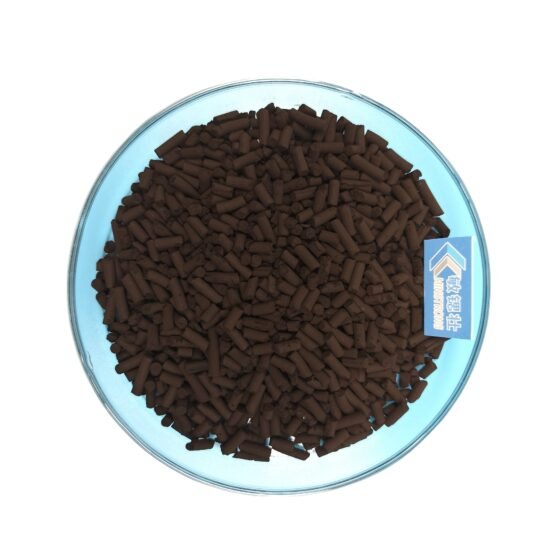
 Catalizadores de la serie Minslite para eliminación de ozono/CO/VOC
El contenido de oxígeno en los gases de escape es la variable principal para seleccionar el monóxido de carbono. (CO) catalizadores. Cuando el oxígeno excede 5%, un catalizador aeróbico es la elección correcta. Utiliza oxígeno en fase gaseosa para convertir CO en CO₂ y funciona continuamente sin regeneración.. Cuando el oxígeno cae por debajo 0.5%, un catalizador anaeróbico se vuelve obligatorio. Depende del oxígeno reticular de los componentes activos para impulsar la reacción.. Después de la reducción, el catalizador necesita una regeneración periódica con un gas que contenga oxígeno. La temperatura también guía la selección.. En condiciones ambientales (20–40°C), Se prefieren los catalizadores de hopcalita.. En el 80–200°C gama con requisitos de larga duración, Los catalizadores de metales preciosos ofrecen claras ventajas a baja temperatura.. En el 150–250°C cocina con escape limpio, Los óxidos mixtos de metales no preciosos reducen los costos de materiales en aproximadamente 70–80%. Este artículo comienza con las definiciones básicas de catalizadores de CO aeróbicos y anaeróbicos.. Luego examina sus diferencias mecanísticas., parámetros de rendimiento, y escenarios de aplicación típicos. La discusión también propone una estrategia de selección centrada en el contenido de oxígeno., ventana de temperatura, resistencia al envenenamiento, y ciclos de regeneración.
1. Definiciones básicas y mecanismos de reacción de catalizadores de CO aeróbicos y anaeróbicos
Catalizadores de CO aeróbicos Trabajar en corrientes de gas con suficiente oxígeno.. Utilizan O₂ en fase gaseosa como oxidante para convertir CO en CO₂.: 2CO + O₂ → 2CO₂. El catalizador proporciona sitios activos para acelerar la reacción y permanece sin cambios después.. Esto permite un funcionamiento continuo sin regeneración.. En condiciones ricas en oxígeno, La oxidación catalítica aeróbica sigue el mecanismo de Mars-van Krevelen.. El CO extrae el oxígeno de la red de la superficie del catalizador para formar CO₂, dejando vacantes de oxígeno. El O₂ en fase gaseosa luego repone estas vacantes. Los ejemplos representativos incluyen catalizadores de hopcalita. (Óxidos mixtos de cobre y manganeso.) y catalizadores soportados en metales preciosos (punto, sistemas pd).
Catalizadores anaeróbicos de CO Se utilizan en corrientes de gas con oxígeno extremadamente bajo o nulo.. El oxígeno para la reacción proviene del oxígeno reticular de los componentes activos.. El CO reacciona con el oxígeno de esta red en la superficie del catalizador para formar CO₂., que reduce el catalizador. Luego, el catalizador reducido debe regenerarse periódicamente haciendo pasar un gas que contiene oxígeno a través de él.. Esto restaura el oxígeno de la red.. La diferencia esencial entre los dos tipos radica en la fuente de oxígeno.. Los catalizadores aeróbicos dependen del O₂ en fase gaseosa., mientras que los catalizadores anaeróbicos dependen de su propia red de oxígeno. Como consecuencia, Los catalizadores aeróbicos operan en un “uso continuo, sin regeneración” modo. Los catalizadores anaeróbicos siguen una “uso-reducción-regeneración” patrón cíclico.
2. La variable de decisión clave: Contenido de oxígeno en los gases de escape
La medición precisa de la fracción de volumen de oxígeno es el primer paso en la selección. Utilice un analizador de oxígeno electroquímico o paramagnético.. Tome al menos tres muestras consecutivas aguas arriba del lecho del catalizador y promedie los resultados..
Condiciones aeróbicas (O₂ > 5%): El oxígeno en fase gaseosa participa directamente como reactivo.. El catalizador proporciona sólo sitios activos., permanece sin cambios, y opera continuamente. Esto se aplica a los gases de escape industriales en la atmósfera del aire., ventilación de mina, escape automotriz, y escenarios similares.
Condiciones anaeróbicas (O₂ < 0.5%): El oxígeno en fase gaseosa es insuficiente para mantener la reacción.. El catalizador debe suministrar oxígeno reticular como fuente de oxígeno.. Después de la reacción, El catalizador se reduce y requiere regeneración.. Esto se aplica al gas de síntesis., purificación de gas inerte, atmósferas circulantes cerradas, y aplicaciones similares.
rango límite (0.5% < O₂ < 5%): Si la concentración de CO es baja y la temperatura es moderada, Se pueden utilizar catalizadores aeróbicos a carga reducida.. Si se requiere una purificación profunda (salida CO < 1 ppm), sin embargo, Se deben considerar catalizadores anaeróbicos o suministro adicional de oxígeno.. Los estudios muestran que cuando la concentración de oxígeno cae abruptamente de 10% a 0%, La conversión de CO cae de 99% y finalmente se estabiliza en aproximadamente 12%. Esto ilustra claramente que la presencia de oxígeno en fase gaseosa es crítica para mantener la actividad catalítica..
3. Características técnicas y aplicaciones típicas de los catalizadores de CO aeróbicos.
La oxidación catalítica aeróbica de CO abarca tres soluciones técnicas principales.
Catalizadores de hopcalita (Óxidos mixtos de cobre y manganeso)
Los catalizadores de hopcalita están compuestos de CuO y MnO₂.. A temperatura ambiente (20–40°C), Ofrecen conversión de un solo paso >99% y salida CO ≤ 5 ppm. Las velocidades espaciales típicas varían desde 5,000 a 20,000 h⁻¹. Los componentes activos son dióxido de manganeso y óxido de cobre.. Con un Cu:Mn relación molar entre 1:1 y 1:2, La conversión de CO puede exceder 90% a 25ºC. La velocidad espacial máxima puede alcanzar 30,000 h⁻¹. Para oxidación de CO a baja temperatura, Los catalizadores de hopcalita suelen tener áreas de superficie BET en el rango de 120–220 m²/g. La temperatura de calcinación afecta directamente la cristalinidad y la actividad.. Muestras de baja cristalinidad calcinadas a 280–350°C mostrar sobre 2.3 veces la actividad específica de muestras altamente cristalinas calcinadas a 500°C.
Sin embargo, Los catalizadores de hopcalita tienen limitaciones importantes en cuanto a la humedad y la sensibilidad al azufre.. A humedad relativa >40%, la actividad cae en más de 50% en cuestión de horas. En humedad >60%, la vida efectiva es <500 horas. Los datos de las pruebas muestran que en condiciones iniciales de 25°C, 40% RH, y 20,000 h⁻¹ velocidad espacial, una muestra con Cu:manga = 1:1.5 logra la conversión inicial de CO de 98.2%. Cuando la humedad relativa aumenta a 80%, sin embargo, La conversión de CO de la misma muestra cae de 96% a 43% en solo 2 horas. Cuando la humedad relativa excede 50%, La carga del catalizador normalmente debe incrementarse en 30–50% para mantener la misma especificación de gas de salida.
Los catalizadores de hopcalita son adecuados para cámaras de refugio en minas., máscaras de gas, y purificación a temperatura ambiente en unidades de separación de aire. En una aplicación de cámara de refugio de minas, El sistema trata el aire circulante con 400 ppm de CO y 35% RH. A 0.3 m³ de carga de catalizador de cobre-manganeso a 12,000 h⁻¹ mantuvo la salida de CO por debajo 5 ppm después 6 meses de operación. En otro proyecto de cámara de refugio minero, Se requieren gránulos de hopcalita de alta cristalinidad calcinados a 500 °C. 90 segundos para reducir el CO de 400 ppm a 20 ppm. El cambio a un producto de baja cristalinidad calcinado a 320 °C del mismo proveedor redujo ese tiempo a solo 55 segundos en condiciones idénticas.
Catalizadores de metales preciosos (punto, PD apoyado)
Estos catalizadores tienen temperaturas de encendido alrededor 80°C. Logran una conversión completa en 120–150°C. Pt/Al₂O₃ logra > 99% conversión a 120°C, 30,000 h⁻¹, y 1,000 ppm CO concentración de entrada. La tolerancia al SO₂ es <100 ppm, con una vida de diseño de 3–5 años. El costo inicial es 3–5 veces el de hopcalita. Sin embargo, La recuperación de metales preciosos después de su eliminación es 85–95%, que compensa 30–50% del costo inicial a través del valor residual. Las aplicaciones incluyen gases de escape industriales que contienen azufre o cloro., escape automotriz, y unidades de producción continua de larga duración. En una planta química, El escape contenía entre 800 y 1200 ppm de CO., acerca de 50 ppm SO₂, y tenia una temperatura de 150°C. Un catalizador de metales no preciosos perdido 40% de su actividad después 2 meses. Después de cambiar a un catalizador a base de platino (punto 0.3 % en peso), el sistema mantenido >98% conversión después 26 meses de funcionamiento continuo.
Óxidos mixtos de metales no preciosos (Sistemas Cu‑Mn‑Ce‑Co)
El sistema representativo CuO‑CeO₂ logra >99% conversión a 200°C y 15,000 h⁻¹. Su costo es solo 20–30% de alternativas de metales preciosos. Sin embargo, es sensible al azufre: en SO₂ >30 ppm, se forman sulfatos irreversibles. Esto requiere desulfuración aguas arriba para <10 ppm.
4. Características técnicas y aplicaciones típicas de los catalizadores anaeróbicos de CO
Los catalizadores anaeróbicos dependen del oxígeno reticular de sus componentes activos para oxidar el CO directamente a CO₂ en condiciones libres de oxígeno.. Después de la reducción, deben regenerarse periódicamente con gas que contiene oxígeno para restaurar su función. Los estudios han demostrado que en condiciones de pulso sin oxígeno, Algunos catalizadores pueden reaccionar con CO usando oxígeno reticular en 180°C. El oxígeno de la red migra continuamente desde la red cristalina para participar en la reacción.. El CO se adsorbe y reacciona inmediatamente con el oxígeno reticular., desorbiendo como CO₂.
Los catalizadores anaeróbicos tienen componentes centrales como En, Fe₂O₃, soportado sobre tamices moleculares o Al₂O₃. Las temperaturas de funcionamiento normalmente oscilan entre 150–300°C, con eficiencia de purificación ≥99% y salida CO ≤ 1 ppm. Las principales ventajas incluyen la ausencia de suministro externo de oxígeno., fuerte resistencia a las impurezas, e idoneidad para la purificación de precisión.
Las aplicaciones típicas incluyen la purificación de gases de síntesis., purificación de gas inerte, eliminación de monóxido de carbono de gases de alta pureza, y atmósferas circulantes cerradas. En gas de síntesis (CO+H₂) purificación, Los catalizadores anaeróbicos de desoxigenación pueden reducir el oxígeno residual a menos de 1 ppm. Además, Se utilizan en unidades de separación de aire y sistemas de compresores para la eliminación de CO a temperatura ambiente..
5. Comparación de escenarios de aplicación para catalizadores aeróbicos y anaeróbicos
El contenido de oxígeno determina la selección del tipo de catalizador.. Los catalizadores aeróbicos funcionan continuamente sin regeneración en condiciones ricas en oxígeno.. Son adecuados para sistemas abiertos como extracción de aire industrial., ventilación de mina, y escape de automóviles. Catalizadores anaeróbicos, en contraste, Requieren regeneración periódica en condiciones libres de oxígeno.. Son adecuados para sistemas cerrados o con bajo contenido de oxígeno, como el gas de síntesis., purificación de gas inerte, y atmósferas de circuito cerrado.
En aplicaciones industriales prácticas, Los dos tipos de catalizadores no son intercambiables.. Los catalizadores aeróbicos no pueden funcionar en condiciones anaeróbicas, sin oxígeno en fase gaseosa., la reacción no puede continuar. Los catalizadores anaeróbicos utilizados en condiciones aeróbicas tendrán ciclos de regeneración más cortos y mayores costos operativos.. Además, Los estudios de laboratorio muestran que la oxidación del CO en condiciones aeróbicas puede ocurrir a temperaturas más bajas., mientras que la oxidación anaeróbica requiere una mayor energía de activación..
| Aspecto de comparación | Catalizadores aeróbicos | Catalizadores anaeróbicos |
|---|---|---|
| fuente de oxigeno | O₂ en fase gaseosa | Oxígeno de red catalizadora |
| Contenido de O₂ adecuado | > 5% | < 0.5% |
| Modo de funcionamiento | Uso continuo, sin regeneración | Uso – reducción – regeneración cíclica |
| Aplicaciones típicas | escape industrial, ventilación de mina, escape automotriz | Purificación de gas de síntesis, purificación de gas inerte, sistemas de circuito cerrado |
| Temperatura de reacción | Ambiente a 400°C (dependiendo del tipo de catalizador) | 150–300°C |
| Profundidad de purificación | Salida CO ≤5 ppm (Hopcalita) | Salida CO ≤1 ppm |
6. Marco de decisión integral para la selección de catalizadores
La selección adecuada debe considerar varios factores.. Estos incluyen la concentración de CO, temperatura de reacción, humedad, composición del gas, velocidad espacial, requisitos de caída de presión, y resistencia mecánica del catalizador.
- Determinar el contenido de oxígeno.: Mida la fracción volumétrica de O₂ en el escape y clasifíquela como aeróbica. (>5%), anaeróbico (<0.5%), o límite (0.5–5%).
- Ventana de temperatura de coincidencia: En ambiente (20–40°C), prefiero hopcalita. En el rango de 80 a 200 °C con requisitos de larga duración, Los catalizadores de metales preciosos ofrecen actividad a baja temperatura.. En el rango de 150 a 250 °C con escape limpio, Los óxidos mixtos de metales no preciosos reducen el costo del material entre un 70 % y un 80 %..
- Evaluar el envenenamiento y la resistencia a la humedad.: Escape que contiene azufre, cloro, o alta humedad requiere una evaluación adicional. El vapor de agua es la causa principal de la pérdida de actividad a baja temperatura en los catalizadores de hopcalita.. Cuando la humedad relativa excede 50%, La carga de catalizador generalmente debe aumentarse entre un 30% y un 50% para mantener el mismo estándar de gas de salida.. Óxidos de azufre (SOx) en los gases de combustión son una de las principales causas de la desactivación del catalizador de oxidación de CO.
- Calcular el coste total de propiedad: Los catalizadores no son materiales consumibles.; generalmente se miden por volumen. Considere la densidad aparente, eficiencia catalítica, vida útil, y otros factores. Los catalizadores de metales preciosos tienen altos costos iniciales pero un valor residual significativo (85–95% de recuperación). Los catalizadores no preciosos son más baratos pero más exigentes en cuanto a las condiciones de funcionamiento..
Resumen del principio de selección: Las condiciones aeróbicas eligen catalizadores aeróbicos.; Las condiciones anaeróbicas eligen catalizadores anaeróbicos.. Temperatura ambiente elija Hopcalite; baja temperatura elija el tipo de metal precioso; temperatura media-alta elija tipos de metales no preciosos o anaeróbicos. La lógica central es: primero coincide con el escenario, luego equilibrar los indicadores de desempeño, y finalmente calcular el costo total.
7. Precauciones y conceptos erróneos comunes sobre la selección
- Error 1: Ignorar la medición del contenido de oxígeno. Seleccionar sin medir con precisión el contenido de oxígeno puede conducir a un tipo de catalizador incorrecto.
- Error 2: Pasando por alto los efectos de la humedad. Los catalizadores de hopcalita son sensibles al vapor de agua.. Para condiciones de alta humedad, considerar catalizadores de metales preciosos o deshumidificación previa.
- Error 3: Comparar solo el precio sin considerar el costo del ciclo de vida. Elegir el catalizador más barato puede llevar a reemplazos frecuentes, tiempo de inactividad del sistema, y costos ocultos.
Precauciones: Los catalizadores aeróbicos no se pueden utilizar en condiciones anaeróbicas, sin oxígeno en fase gaseosa., la reacción no procederá. Los catalizadores anaeróbicos utilizados en condiciones aeróbicas tendrán ciclos de regeneración más cortos y mayores costos operativos.. Los gases de escape que contienen azufre requieren desulfuración aguas arriba, De lo contrario, el catalizador se desactivará rápidamente.. La temperatura de funcionamiento óptima para los catalizadores Hopcalite es la temperatura ambiente. (20–40°C); por encima de 100°C, Se produce una sinterización irreversible de los componentes activos..
8. Conclusión
La selección entre catalizadores de CO aeróbicos y anaeróbicos se basa fundamentalmente en el contenido de oxígeno de la corriente gaseosa.. Cuando O₂ > 5%, utilizar catalizadores aeróbicos. Cuando O₂ < 0.5%, Los catalizadores anaeróbicos son obligatorios.. Entre los catalizadores aeróbicos, Los catalizadores de hopcalita se distinguen por su alta actividad a temperatura ambiente. (>99% Conversión de un solo paso a 20–40 °C) y bajo costo, haciéndolos adecuados para secar, condiciones limpias. Los catalizadores de metales preciosos ofrecen una excelente resistencia al azufre y una larga vida útil. (3–5 años) por duro, Escape que contiene azufre y humedad.. Óxidos mixtos de metales no preciosos, a sólo el 20-30% del costo de los metales preciosos, Adecuado para escenarios de escape limpio a temperatura media.. Catalizadores anaeróbicos, con su profunda capacidad de purificación (salida CO ≤1 ppm) e independencia del suministro externo de oxígeno, Proporcionar soluciones para aplicaciones sin oxígeno, como la purificación de gases de síntesis y la purificación de gases inertes.. La selección adecuada debe seguir el proceso de decisión de “determinación del contenido de oxígeno → coincidencia de la ventana de temperatura → evaluación de la resistencia al envenenamiento → evaluación del costo total”. Para usuarios industriales, Establecer una cadena de gestión completa de “diagnóstico de condición – selección de catalizador – monitoreo de operación – mantenimiento de regeneración” es la garantía fundamental para lograr el logro a largo plazo., Operación de catalizador de CO de bajo costo.
autor: gloria
fecha:2026/9/3
WeChat
Escanea el código QR con WeChat