 Minslite Series Catalysts for Ozone/CO/VOCs Removal
In industries such as spray coating, printing, and chemical manufacturing, the low-temperature purification of carbon monoxide (CO) poses a significant challenge for many enterprises. While precious metal catalysts offer excellent performance, they come with a high price tag; conversely, conventional non-precious metal catalysts often “stall” when operating at low temperatures. The critical question remains: can copper oxide catalysts effectively oxidize CO at low temperatures? The answer is a resounding yes.
I. The Low-Temperature Catalytic Mechanism of Copper Oxide
The ability of copper oxide (CuO) to efficiently catalyze CO oxidation at relatively low temperatures stems from two core characteristics:
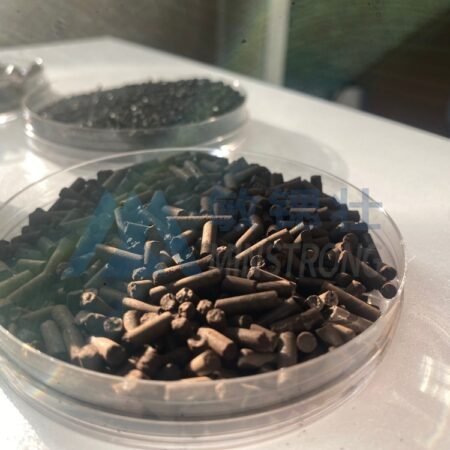
Copper Oxide Catalyst
1. The Variable-Valence Cycle of Copper Ions
Copper atoms can reversibly switch between the Cu²⁺ and Cu⁺ oxidation states. This continuous redox cycle provides a low-energy reaction pathway for the oxidation of CO. A CO molecule acquires an oxygen atom from the catalyst surface to form CO₂, while the cyclical change in copper’s oxidation state continuously drives this process forward.
2. Abundant Oxygen Vacancies
The surface of nanoscale copper oxide features a high density of oxygen vacancies—structural defects capable of efficiently adsorbing and activating oxygen molecules. This significantly lowers the activation energy required for CO oxidation. Research indicates that by forming composites with cerium oxide (CeO₂) or manganese dioxide (MnO₂), the concentration of oxygen vacancies can be further enhanced, thereby lowering the catalytic ignition temperature to below 80°C.
II. Performance Data: How Strong is Its Low-Temperature Performance?
A nanoscale CuO-CeO₂ composite catalyst can achieve a CO conversion rate exceeding 90% at temperatures as low as 66°C.
Cu-Ce fiber catalysts fabricated via electrospinning can achieve complete CO oxidation at 90°C.
CuO/Cu₂O heterojunction catalysts leverage the advantages of oxygen vacancies to reduce the temperature required for complete oxidation from 250°C down to 140°C.
“Hopcalite” (a CuO-MnO₂ mixture) demonstrates stable performance within the 75–150°C range, maintaining undiminished catalytic activity even after 48 hours of continuous operation.
III. Comparison with Precious Metals: A Generational Advantage in Cost-Effectiveness
Although precious metal catalysts—such as those based on platinum or palladium—can achieve ignition temperatures as low as 80°C, their raw material costs are several dozen times higher than those of copper oxide. For clean waste gas with flue gas temperatures ranging from 80°C to 200°C, copper oxide-based catalysts serve as a fully viable alternative to precious metal catalysts, offering initial investment savings of 60% to 80%. Furthermore, while spent copper oxide catalysts typically hold no intrinsic recovery value, their replacement frequency is manageable; consequently, the overall operating costs remain significantly lower than those associated with precious metal systems.
IV. Enterprise Pain Points and Selection Recommendations
Copper oxide catalysts are not a universal solution. Their primary limitations lie in their relatively poor resistance to moisture and sulfur. Waste gas characterized by high humidity (RH > 60%) or the presence of sulfur compounds can lead to the rapid deactivation of the catalyst.
Based on varying operating conditions, the following recommendations are offered:
Low-Temperature, Clean Waste Gas (Sulfur-free, Low Humidity): The preferred choice is a nano-CuO/CeO₂ composite catalyst, which offers the highest cost-effectiveness.
High-Humidity or Sulfur-Containing Waste Gas: It is necessary to install upstream drying or desulfurization units, or to consider utilizing precious metal catalysts instead.
Waste Gas with Significant Flow Rate Fluctuations or Unstable Temperatures: It is recommended to integrate a pre-treatment system to ensure stable inlet conditions for the catalyst.
V. Take Action Now
If you are currently facing challenges in the low-temperature treatment of carbon monoxide (CO) emissions, or if you are deliberating between precious metal and non-precious metal catalyst options, we invite you to contact us. We offer complimentary diagnostic assessments of waste gas conditions and small-scale sample testing of our copper oxide catalysts, enabling us to assist you in making a precise catalyst selection within just 30 days. Click to consult with us and receive a customized technical solution tailored to your specific needs.
author:kaka
date:2026/4/7
WeChat
Scan the QR Code with WeChat