 Ozon/CO/VOC-lərin çıxarılması üçün Minslite seriyası katalizatorları
Choosing the wrong ozone decomposition catalyst can lead to four serious consequences: risk of combustion and explosion, excessive emissions, equipment damage, and significantly shortened lifespan. The most serious consequence is that misusing catalysts containing activated carbon in high-concentration ozone environments can cause combustion or even explosions. Improper selection leading to non-compliance with emission standards will result in environmental penalties and production shutdowns for rectification. Correct catalyst selection should follow these five principles: select the appropriate type based on ozone concentration, determine humidity resistance requirements based on humidity conditions, calculate the loading amount based on space velocity, assess coexisting pollutants to avoid poisoning risks, and consider pressure drop limitations when selecting the catalyst form. The following discussion focuses on four types of risks and corresponding mitigation measures.
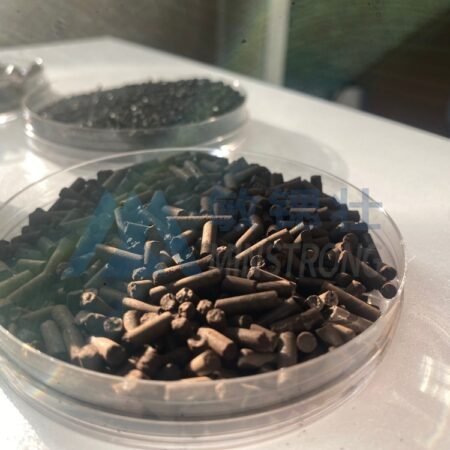
Ozon parçalanma katalizatoru
I. Risk of Combustion and Explosion: The Most Serious Consequence of Choosing the Wrong Catalyst in High-Concentration Environments
In high-concentration ozone environments (typically semiconductor wafer manufacturing exhaust gas or ozone generator exhaust gas, where ozone concentration is typically ≥500 ppm), the catalytic decomposition reaction releases a large amount of heat. The enthalpy change of ozone decomposition into oxygen is -34 kcal, meaning that the decomposition of 1 mole of ozone releases 34 kilocalories of heat.
If you mistakenly select a catalyst containing activated carbon, zeolite, or other flammable components under such operating conditions, the consequences are extremely serious: the system cannot dissipate the heat of reaction in time, and the bed temperature may rise to over 600°C within seconds, reaching the ignition point of activated carbon, causing the catalyst bed to burn or even explode. Numerous records from both domestic and international sources document fires in ozone decomposition units caused by incorrect catalyst selection.
Prevention Measures
In high-concentration scenarios, you must use pure manganese-based or manganese-copper composite oxide catalysts without any flammable components. You must also require suppliers to clearly specify the catalyst composition and provide thermal stability test data during selection.
II. Exceeding Emission Standards: Insufficient Catalyst Performance Leads to Environmental Violations
Exceeding emission standards is the most common and direct consequence of catalyst selection errors. When the activity of the selected catalyst cannot match the actual operating conditions, the catalyst cannot completely decompose ozone, and the outlet ozone concentration will exceed environmental standard limits.
According to the Chinese national standard Indoor Air Quality Standard (GB/T 18883-2002), the indoor ozone limit is 0.16 mg/m³ (approximately 0.08 ppm). Regarding industrial waste gas emissions, the Integrated Emission Standard of Air Pollutants (GB 16297-1996) sets clear limits for ozone emissions. Exceeding these limits may result in environmental fines, deadlines for rectification, or even production shutdowns.
Selection errors leading to excessive emissions include:
- using a low-concentration dedicated catalyst when treating high-concentration ozone;
- failing to calculate the packing volume based on space velocity when treating large air volumes, resulting in insufficient catalyst volume;
- using a conventional catalyst without moisture resistance under high humidity conditions.
Mitigation Measures
Before selecting a catalyst, thoroughly assess the operating parameters (concentration, air volume, rütubət), calculate the packing volume using the space velocity formula (catalyst volume = treated air volume ÷ design space velocity), and require the supplier to provide a third-party testing report as performance evidence.
III. Equipment Damage: Uncontrolled Pressure Drop and Corrosion Issues
Selecting the wrong catalyst morphology or particle size can cause the system pressure drop to exceed the design range. While catalysts with excessively fine particles (məs., particle size <1 mm) have high activity, they significantly increase airflow resistance—when the pressure drop exceeds the fan’s rated head, the system airflow decreases, reducing processing efficiency, and in severe cases, potentially burning out the fan motor.
Furthermore, inferior catalysts may pulverize during operation. The airflow carries the fine particles generated by pulverization into downstream equipment, potentially clogging pipes and damaging precision instruments. In environments with extremely high cleanliness requirements, such as semiconductor manufacturing, this contamination can lead to the scrapping of an entire batch of wafers.
Mitigation Measures
Provide the supplier with the maximum allowable pressure drop of the system and fan parameters, and have them recommend a suitable catalyst morphology and particle size. Regularly check the catalyst bed condition for pulverization or agglomeration.
IV. Significantly Reduced Lifespan: Frequent Replacement Costs Due to Premature Failure
Improper catalyst selection can significantly shorten the effective lifespan of the catalyst. The following three scenarios are most typical:
High Humidity Conditions Without Moisture-Resistant Catalysts
When relative humidity exceeds 80%, water molecules compete with ozone for active sites on the catalyst surface, leading to decreased activity. More seriously, water vapor accumulation can cause irreversible structural damage. Under such conditions, this may shorten the lifespan of conventional catalysts from the normal 3-5 years to 3-6 months.
Halogen/Sulfide-Containing Conditions Without Anti-Poisoning Formulas
Substances such as chlorine, hydrogen fluoride, and hydrogen sulfide can react with the active components of the catalyst, generating inactive metal compounds. You cannot restore poisoned catalysts through heating regeneration; you must replace them entirely.
Excessively High Space Velocity Design
Space velocities exceeding the catalyst’s processing capacity will result in insufficient contact time between ozone and the catalyst, leading not only to instantaneous emissions exceeding limits but also accelerated loss of active components due to prolonged high-load operation.
Mitigation Measures
Provide the supplier with complete operating parameters, including humidity, types and concentrations of coexisting pollutants. For borderline operating conditions, we recommend conducting small-scale laboratory tests or requesting application cases under similar conditions for reference.
Summary
In summary, the cost of choosing the wrong ozone decomposition catalyst goes far beyond equipment procurement costs—from the risk of combustion and explosion to environmental penalties, from equipment damage to frequent replacements, each mistake can lead to economic losses far exceeding the catalyst’s intrinsic value. You should base scientific selection on a comprehensive assessment of operating conditions, making matching decisions across five dimensions: concentration, rütubət, space velocity, coexisting pollutants, and pressure drop. We recommend that you provide suppliers with a complete table of operating parameters during the selection process and request third-party testing reports or similar application case studies as verification evidence.
müəllif: Qloriya
tarix:2026/4/29
WeChat
WeChat ilə QR kodunu skan edin